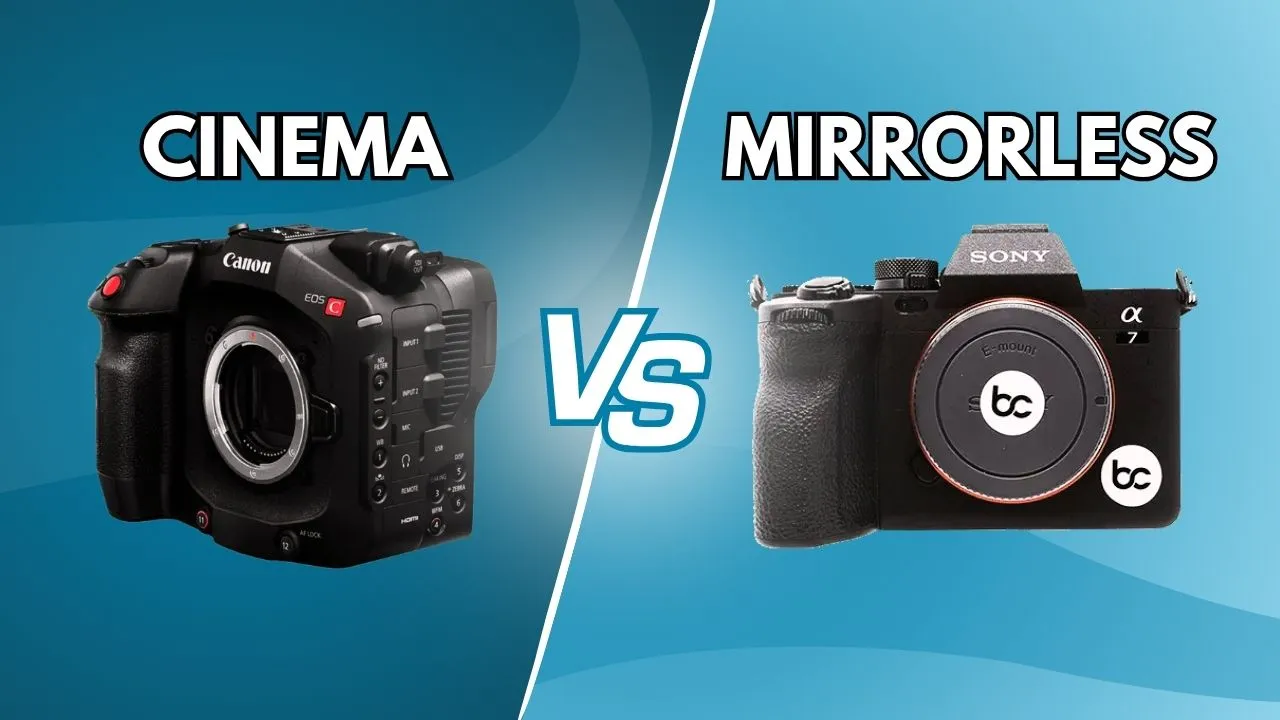
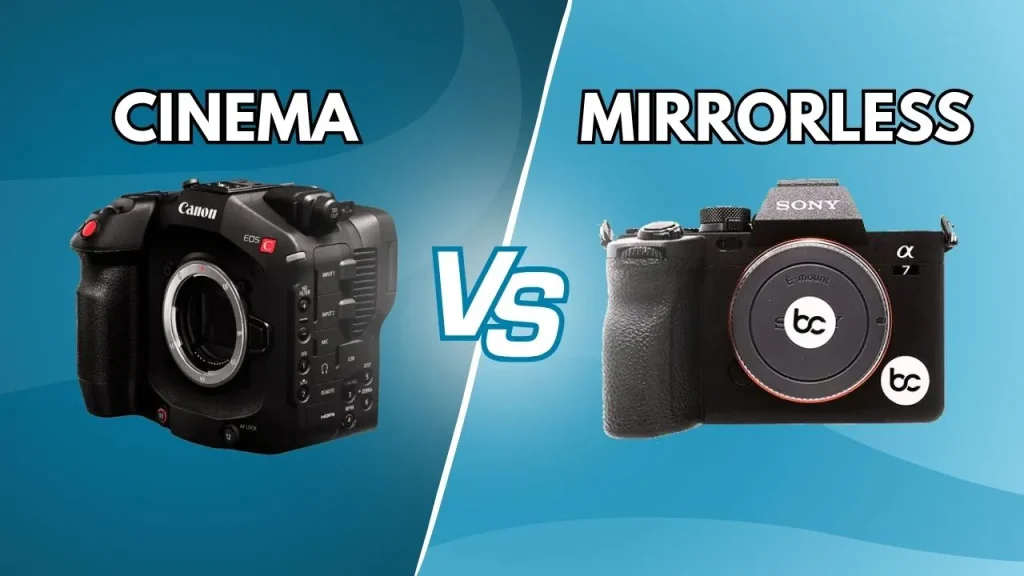
This past week, I had the opportunity to shoot behind-the-scenes (BTS) footage for a music video using a Sony Alpha mirrorless camera, which got me thinking about the Cinema Camera vs Mirrorless debate. While working on set, I started noticing just how different the experience of shooting with a mirrorless camera was compared to the cinema camera being used for the production: the Canon C80.
Whenever I looked at the monitor, I could see distinct differences in the footage from the two cameras, even though we shot both in the same studio environment with the same lighting setups. The crew used the two cameras in very different ways. They required different rigs and accessories, different crew sizes, and ultimately produced different results.
That experience got me thinking: What is the difference between a mirrorless camera and a cinema camera, and which type of camera is right for you?
Thanks to the Canon C80’s 6K full-frame sensor, the footage looked exceptionally clean and detailed, even when viewed on a large director’s monitor. The mirrorless camera also delivered impressive results using 4K RAW, but there was still a visible difference between the two.
For most social media content creators, however, this difference in image quality is unlikely to be noticeable. When viewers primarily watch BTS footage on smaller screens, such as smartphones, the advantages of 6K full-frame footage become much less apparent. Social media platforms also compress video and impose file-size limitations, further reducing the practical benefit of shooting at a higher resolution.
The difference becomes much more significant when you intend to show the footage in a theatre, at a film festival, or on a large display. On a big screen, the additional detail and overall image quality of a cinema camera can be easier to appreciate.
Ultimately, the best camera depends on how you plan to use your footage. For social media and everyday content creation, a mirrorless camera can deliver excellent results and may offer better value and convenience. But for filmmakers planning to screen their work in theatres or at festivals, a cinema camera like the Canon C80 is the preferable choice for maximum image quality.
One of the biggest advantages of a cinema camera vs mirrorless camera is the inclusion of built-in neutral density (ND) filters.
The Canon C80, for example, has up to 16 stops of internal ND filtration. This makes it much easier to control exposure in changing lighting conditions without having to swap filters on the lens.
You can always attach an external ND filter to a mirrorless camera, but doing so can be more time-consuming and may limit the amount of filtration available depending on the system you’re using.
Internal ND filters also give cinema cameras more flexibility when switching between lenses. Because the camera includes a built-in ND system, you don’t need to worry about finding compatible external filters for every lens or filter size.
The biggest advantage, however, is speed.
On a fast-paced film set or live event, internal ND filters allow you to quickly adjust exposure without stopping production. Being able to change your exposure with the push of a button can make a significant difference when lighting conditions are changing quickly.
Another major difference between cinema camera vs mirrorless is how they handle focus.
One of the biggest selling points of a mirrorless camera is its run-and-gun capability. Modern mirrorless cameras often have highly advanced autofocus systems, including subject detection and eye tracking, making it possible for a single operator to capture sharp footage with minimal equipment.
This is particularly useful for:
While modern cinema cameras increasingly offer sophisticated autofocus, professional productions frequently rely on manual focus. On a larger film set, the 1st Assistant Camera (1st AC) may handle focus using a follow-focus system. This allows the focus puller to make precise adjustments based on the movement of the actors and camera.
If you’re shooting by yourself, autofocus can be incredibly valuable. If you’re working with a professional crew, manual focus can provide the level of control required for a more complex production.
Mirrorless cameras are generally compact, lightweight, and easy to handhold. Their smaller form factor makes them ideal for situations where portability and mobility are important.
Cinema cameras are typically larger and built around professional production workflows. Depending on the camera and setup, they may require additional equipment such as a shoulder rig, tripod, gimbal, or EasyRig for stability and operator comfort.
Cinema cameras commonly include professional connections such as XLR audio inputs and SDI or full-size HDMI outputs. These connections make it easier to build a camera system around external monitors, wireless video transmitters, microphones, recorders, and other production equipment.
As a result, cinema cameras tend to excel in collaborative environments where multiple crew members are working together, and mirrorless cameras excel in solo-shooting environments.
Mirrorless cameras are known for their versatility. Unlike a dedicated cinema camera, most mirrorless cameras are designed to capture both high-quality video and high-resolution still photographs.
I chose a mirrorless camera for the BTS footage of this music video partly for this reason. Being able to switch between video and photography meant I could capture behind-the-scenes footage while also taking high-resolution stills throughout the production.
While some cinema cameras can capture still frames, their resolution is generally limited by their video recording resolution. A modern mirrorless or hybrid camera, on the other hand, can offer 45+ megapixels or more, providing significantly more detail and flexibility for photography.
For filmmakers, content creators, and photographers who need one camera system that can handle both photo and video, a mirrorless camera can therefore be the more practical choice.
When deciding between a cinema camera and a mirrorless camera, the right choice ultimately depends on the type of production you’re working on.
If you’re shooting photos and video, working as a solo operator, or need a compact camera for run-and-gun shooting, a mirrorless camera is often the better option. Its smaller size, advanced autofocus, and ability to capture high-resolution photos make it extremely versatile for weddings, events, BTS content, documentaries, travel, and social media.
If you’re working on a large-scale production such as a narrative film, television show, or commercial, renting a cinema camera may be the better choice. Cinema cameras are designed around professional filmmaking workflows, offering features such as built-in ND filters, professional video connections, extensive rigging options, and greater integration with a larger camera crew.
And sometimes, you don’t have to choose just one.
For a production like the music video I worked on, using both types of cameras made the most sense. The production team used the cinema camera for the main production and the mirrorless camera for BTS footage and still photography, allowing the crew to get the most out of both systems.
Whether you’re looking for a cinema camera or a mirrorless setup, Budget Camera has a wide selection available to rent for your next production.

Now Shipping Across Ontario
We have partnered with Purolator to ship select equipment rentals to customers within Ontario. This service is designed to offer filmmakers and video creators across the province more convenience, flexibility, and accessibility.
Important Note
Shipping is available for select items only, with a minimum rental period of 2 days. Contact us to learn which gear is eligible and to confirm shipping costs.
All shipping orders must be confirmed at least 3 business days before the rental start date.
How it works
On the checkout page, select ‘Express Shipping’ under order type, and provide your delivery address.
📝 Request a Quote
Navigate through our gear categories. See what you like, and select "Add to List" or click on the image to learn more.
✅ Order Confirmation
A team member will confirm gear availability and guide you through account creation if it's your first time renting—before completing your reservation.
📦 Pickup & Return
Mon – Fri: 9:00 AM – 6:00 PM
Sat: 10:00 AM – 4:00 PM
🚚 Request Delivery
You can request rental delivery within a 100-mile radius of our Toronto location.
👤 First-Time Renters
First-time renters are required to complete a rental agreement form with a valid ID.
🛡️ COI (Certificate of Insurance)
Independent insurance coverage is required for orders with a total replacement value above $15,000 CAD. Learn More
💳 Security Authorization
A small hold will be placed on your credit/debit card. The hold will be canceled upon the return of the rental.
We offer a convenient delivery service for all our rental gear within a 100km radius of our location. Our goal is to ensure you have everything you need on time and in perfect working condition.
Request: You can request delivery at any time during your reservation—in person, via email, or by phone.
Equipment Testing: All gear is thoroughly tested before delivery to ensure it’s fully functional and ready for use.
Inspection Upon Arrival: When the driver arrives, please inspect the equipment and verify the equipment list to ensure everything is in order.
Rental Requirements: To avoid cancellation, please ensure all rental processes and requirements are completed at least 2 hours before the scheduled delivery time. If not completed, the delivery will be canceled, and rental credit will be applied to your account.
Protection & Responsibility: We ensure all equipment is well-protected and safely transported. Once delivered, the client is responsible for any damage or issues that may arise while the equipment is in their possession.